Showing posts with label shoulder surgery. Show all posts

Friday, March 27, 2015

The Real Scoop on Shoulder Surgery (Part 2)

In the weeks between finding out I was going to have surgery and actually having it, I tried to prepare myself as much as possible. By this point, Hubs was off of crutches and in a walking boot following his ankle surgery. While this was helpful, he was still healing and I wanted to be able to do as much for myself as possible. Also, since we didn't have a clear picture of what was going to be done, I couldn't completely prepare. I was given a best case recovery time frame of six weeks and a worst case of four months to a year. In other words, Hubs would eventually be going back to work, and I needed to be sure I could manage as much as possible without him.

Preparing for Surgery

I read that preparing as much beforehand as possible is helpful. I probably went a little overboard with this. My other problem was that it was my right arm and I'm right-handed. Even things I didn't think would be difficult after surgery were, in fact, hard as Hell. Hear is what I did, including info on what helped, what didn't, and what was overkill.


  • If you have the luxury of time before your surgery, just spend a few days being really aware. When I came out of surgery, anything that involved moving the arm away from the body was prohibited and, frankly, impossible with the sling I was in. Really, we underestimate just how much that involves. For example, did you know that turning a doorknob activates the biceps? I didn't, but I found out. So even things that you think won't hurt or be problematic will be. But this should give you a good idea of how you can adapt your environment to make it work for you.
  • Pants: I forgot that dressing has more to consider than just getting clothes on your body. You also have to be able to get back out of the clothes to bathe, to change. The pants you choose will have to come on and off as you visit the bathroom. I didn't think of this, so one of my days immediately post-op, I had Hubs help me put on jeans, only to later discover that, every time I had to pee, he would have to go into the bathroom with me. Fine at home, but eventually Hubs wouldn't be there and sometimes, even with Hubs there, we wanted to go out in public and he couldn't go into a women's restroom with me. I learned my lesson and from that point, I only wore super-soft stretchy pants that I could pull on and off one-handed. Just now, in about the past month, I am finally able to navigate jeans independently. You just don't realize the strength it takes to button and zip jeans that actually fit you. 
  • Tops: Tops are something I thought out ahead of time. They couldn't be too bulky to fit under the sling, I had to be able to get them on and off without moving my shoulder. This could be accomplished in two ways: something that buttons or zips all the way down, or something that is stretchy and can be pulled on and stretched over the arm. I ended up going to a cheapo store and buying the biggest zip-up men's hoodies I could find and lived in them. I spent about $30. I also took some older ones and cut the sleeve off and cut the arm openings so I could just slide the whole arm, sling and all, through them. That was overkill. The big hoodies I purchased were plenty adequate, comfy, and warm. Added bonus, the hood under the strap for the sling provided comfort. Your neck can  get raw and sore from the sling strap and I didn't have that problem for that reason.
  • Bras: I read somewhere that women should consider just going bra-less in the immediate post-op period. Ha! I'm not going to embarrass myself by going into detail here, but this is not an option for all women. So I decided to go and get cute about it. I figured that it was just a matter of the strap on a shoulder, so I planned on getting a convertible bra where you can change up the straps. Just don't waste your money. Getting it on, getting it off.....I can just now tolerate a bra strap, for starters. And I can just now get one on by fastening the hooks in front and then twisting it around my upper body so the hooks are in the back where they go. But I still, to this day, cannot take one off. I cannot get my bad arm up that high on my back, and I'm not some stud who taught himself how to unfasten a bra one-handed during a make-out session. A tube style bra would work, but if you're chesty like me, that isn't even an option. Instead, I opted for stretched pullover sports bras. They aren't supportive at all, but they make me feel better than going without. For more support or to go out in public, I double them up.
  • Shoes: Didn't think shoes would be an issue, but they were. Slip-ons are perfect, like Toms or laceless Vans or Converse. I didn't buy any special shoes. I took my running shoes and fixed the laces so that I could slide them on and off without using my hands. You won't be able to reach. There was no way I could've tied my own shoes.
  • Deodorant: This was tough. I've been wearing regular deodorant for about a month now, but for right after surgery, I got some aerosol. It's hard to find, but it still exists out there. To put it on, all I had to do was lean over and let my arm dangle, aim and spray.
  • In the shower: shampoos, conditioners, and body washes with pumps worked best. It was too hard to maneuver a bottle without moving both arms. Even when I graduated to moving both arms, it was still painful to manipulate caps. And just like you use your biceps to turn a doorknob, I was told by my therapist that you also use it to make a twisting motion to pour. Just buy pump bottles. If your favorite brands aren't available in them, you can find inexpensive empties in the travel section at the store. 
  • Toileting. Yeah, really. TMI. But it was too hard to wipe with my left arm. I never felt clean, so I bought those wet flushable wipes. I'm not going into any more detail here. If you're lucky and it's your non-dominant arm that is affected, this shouldn't be an issue for you.
  • Around the house: Just look around. Can you sit and watch television and reach a drink on the non-affected side? Can you reach a glass in the kitchen to get yourself a drink, or are they on too high a shelf? We usually buy 2-liters and I was unable to manipulate those caps and manage to pour from them for awhile. We bought our drinks in cans until I could. It's little things like that that were a huge help.
  • Hair: I honestly just gave up here. I usually straighten my hair. Instead, I just used gel and scrunched it and pulled it back in a headband. Hubs once tried to help me put it in a ponytail. It was a disaster and we gave up. But the messy hair was okay, because I lived in hoodies, yoga pants, couldn't do my makeup for several months. So at least it was a cohesive look and nobody said a word because my right arm was in a sling. It was pretty obvious.
  • Ice packs: I didn't buy the cold therapy devices that they sold at my surgeon's office, They were pricey and insurance wouldn't cover them. Instead, I bought several of the big sheet-style cold packs at Wal-Mart. I bought multiples, because ice was one of my pain management necessities. So when one would thaw and lose its coldness, I would swap it for the fresh one already in the freezer. I spent maybe $20 instead of the $120 I would have paid for the machine.
  • Sleeping: I bought more pillows. Lots more. Those cheapo pillows on the end caps at Target? I bought 4 of them. We don't have a recliner, but we do have a large chair-and-a-half with matching ottoman. That's where I slept. Pillows behind my back to prop me up, pillow under my bad arm and beside my bad arm to take some of the weight off of my neck from the sling. I still had to wear the sling to sleep, but with it propped like this, it wasn't hanging there. You can find these pillows for like $5 a piece. They aren't going to stay fluffy forever because they're cheap, but mine are just now starting to wear out and now I don't need them anymore. You will not be able to tolerate laying flat. Don't even try.
  • Meds: I made sure I had the following on hand, and I'm glad I did: Tylenol and Tylenol PM,  Advil and Advil PM. Why all of these? Well, most pain reliever have acetominophen in them and you can't mix Tylenol with them or you'll wreck your liver. And sometimes the pain meds aren't enough and need some help. When I was on those, I took Advil with them during the day and Advil PM at night. When I switched to antiinflammatories (Mobic, Naproxen), I couldn't take ibuprofen with those or I could have GI issues. Enter the Tylenol. And I still need them today, so just buy the big bottle and save some cash.
Okay, enough for now. Part 3 will be the actual surgery.....

Thursday, March 26, 2015

The Real Scoop on Shoulder Surgery (Part 1)

I've had surgeries. I've had orthopedic injuries. I've broken a wrist, sprained an ankle, and once had twelve individual hairline fractures of my foot at one time. I've known pain. In fact, one of my surgeries was an ACL reconstruction. I thought I was prepared. I read up on the surgery I was to have, but we didn't really know specifically what the surgeon would find once in there, so that was kind of difficult. But while I was reading and researching, I came up with some useful advice, but I never found out exactly what I needed to know. So here is my complete shoulder story. Maybe it will help someone.

In the Beginning:
So I had my injury toward the end of July, 2014. I didn't hear any loud pops, but I did feel something give way. Immediately, I couldn't lift my arm away from my body at all. I went to the ER later in the day and was put in an immobilizing sling type of contraption. I was immediately told there was some type of soft tissue injury and referred to an orthopedic surgeon. I saw the guy within a few days of the injury, and he immediately freaked at the immobilizer and told me to not wear it. I was so glad that I tossed it in the trash can in that exam room, right then and there. He was concerned with frozen shoulder, which sounded made up to me, but I assure you now that it is not. With my physical exam and nature of the injury, he was concerned about a labrum tear. I was told then that there was no way I could work, and to just give it up for now.

The Arthrogram
If you have never had one of these, well, I don't even know what to say. I've heard some say they're awful and I've heard some say they didn't bother them at all. It took three weeks to get in have mine done--insurance gave us fits. By then, my shoulder felt even worse and was really stiff. I couldn't sleep, and I couldn't move my arm away from my body at all without horrible sharp pains that felt like my shoulder was going to be ripped apart.
For the arthrogram, they use imaging to inject dye into the actual joint. It's a big needle, but they give you a local first. That stings a little, but not too bad. The big needle? Didn't even feel it. The part I did feel was an intense achiness and just general weirdness as they filled the joint with dye. The shoulder doesn't have a lot of space, so the excess fluid made it feel full and kind of blech, but I do believe that there is also numbing medication in it, so it isn't too bad. You then go straight for an MRI so they can visualize all of that dyed goodness.
I will tell you that after the arthrogram is no fun at all. It hurt. It hurt really badly. I'm not dure if this was soreness from big needle going through muscle, and injured joint now filled with excess fluid, or a combo of both, but once the numbing medication wore off, all I could do was lay on my sofa with an ice pack and hope my children didn't destroy me or the house. It seriously hurt to move my upper body at all. That was the first time, in over a month of this shoulder injury, that I asked for pain medication beyond Tylenol. And took it, too.
Me, after the arthrogram and after pain meds. As I recall, I texted this to my husband at work to tell him I was miserable and to hurry home.
Also, the morning after the arthrogram, I had some mild bruising where the injection took place.


The Puzzling Results, the Hubs Debacle,  and More Crap
My arthrogram was negative. I think it showed some inflammation of my biceps. No labral tear, no rotator cuff tear. I was diagnosed with frozen shoulder (adhesive capsulitis) at this point. I was given a cortisone injection---ugh!---and prescribed antiinflammatories. Of course there was also rest and physical therapy. At this point, it happened. And by it, I mean I got a phone call that Hubs, the big dork, had fallen through a ceiling at work and was in the ER. He ended up coming home on crutches, seeing his very own orthopedic surgeon, and was scheduled for ankle syndesmosis repair within a week.
Suddenly that rest we had talked about was pretty much non-existent. Hubs ended up getting a plate, a couple of screws and some anchors. He came home from surgery on Oxycontin every 12 hours with Percocet every 4 hours in between for breakthrough pain. He had to take all of the above with Phenergan to prevent nausea. This was only for a few days, but in those few days, I was filling ice bags, cooking his small meals, helping him bathe and dress, helping him change positions every few hours. I did all of this around the clock--the meals especially, so he could eat and take his pain medications. Within 24 hours of that first day of that, my shoulder started to do this:


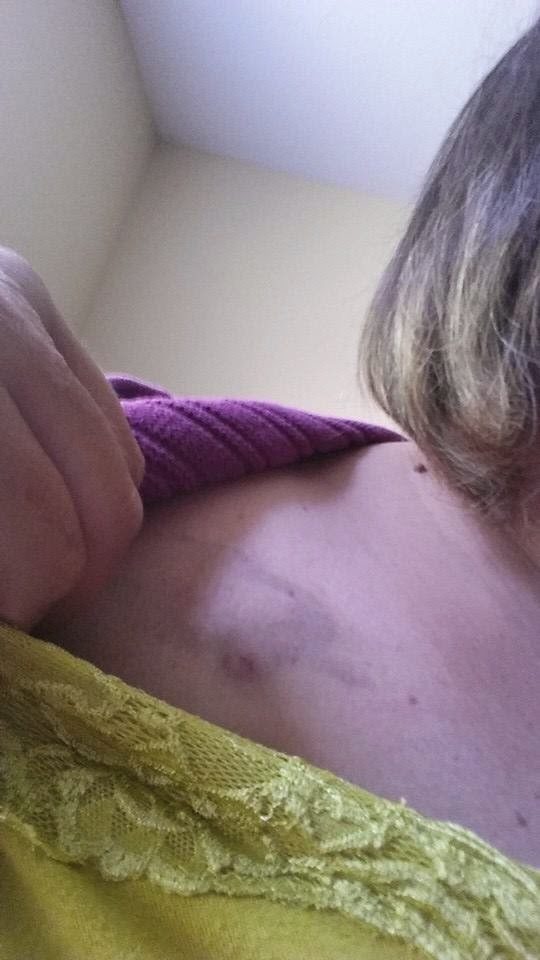
Out of concern, I saw my surgeon. I was told it was probably a "red herring" and not to read too much in to the random bruising. Incidentally, my pain was worse, also. Physical therapy's importance was stressed, and I teared up as I told them I hadn't really been compliant with that because of Hubs and needing to be able to care for him. I did start PT and worked on range of motion and light strength training. This is where I tell you how much I love my physical therapist. She told me she didn't think there was an issue with frozen shoulder, as she could passively move my arm, I just couldn't actively do it. She vowed to watch it for progress while we continued to work together for weeks. Throughout this, I continued to follow-up with the surgeon. My diagnosis changed off and on. At times, I exhibited symptoms of anything from biceps tendonitis to supraspinatus strain. Physically, nothing ever really changed. I got my range of motion back, but never lost even a smidge of the pain and never got strength back in that arm. This starts the chain of events that lead to surgery.

We Need to Just Go in There and Take a Look
When I never improved despite strict compliance and serious PT work, I had continued to have random bruising pop up whenever we would change anything up in PT. My therapist was still concerned and actually convinced the surgeon to repeat an MRI. We were awaiting those results. I was going to PT on Mondays and Wednesdays. This one Monday, about four months after injury, we had started biceps exercises that weren't too bad. Of course, there was more random bruising, and I reported for Wednesday's session looking like this:

My therapist actually advised me to take that picture, because she wanted to be sure the surgeon saw it. I had a follow-up the following day to get those MRI results, so I didn't have to even bring it up. I saw my surgeon's NP and she saw it immediately. Of course the new MRI still didn't show anything but biceps strain. Everything seemed to be intact. Nevertheless, the NP brought the surgeon in to be sure. At this point, it was deemed warranted to go in there and actually see what was happening. Before I knew it, I was being fitted for a post-op sling and scheduled for surgery. I picked a busy surgeon, so I had to wait a couple of weeks for--get this--shoulder arthroscopy with possible rotator cuff repair, possible biceps tenodesis, possible subacromial decompression, possible labrum repair, possible acromioplasty. Gotta love informed consent.

This went on way more than I expected, so I'll post about the prep for surgery, survival tips, and the actual experience in a second post. I really hope this helps someone.